
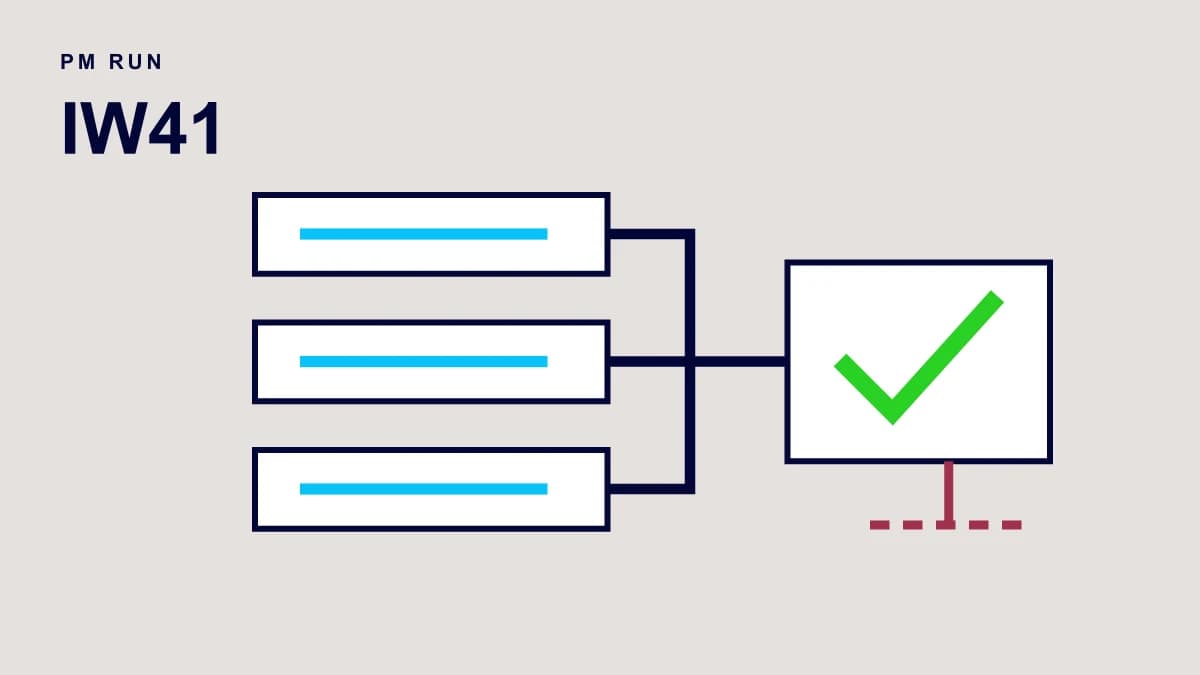
An SAP PM confirmation records what happened in the operation, not what was planned. IW41 can create the confirmation, but quality depends on the correct order and operation, actual hours, coherent dates, named technician, technical text, completion indicator, and error or cancellation treatment.
Copying planned hours, entering an entire shift later, posting to a generic operation, or marking completion with open work makes productivity, cost, and history unreliable. A confirmation must retain enough context for planning, reliability, and finance to use the record without reconstructing the shift through interviews.
IW41 records the confirmation, but quality starts with operation design and ends with result reconciliation. Technical object, order, operation, user, time, status, response, exception, and evidence stay connected when spreadsheets, queues, integrations, or offline work participate in the flow.
The operational decision recorded through IW41
The design starts before entry. The triggering event, preconditions, decision rights, official document, and acceptance evidence must be known, along with routes for unavailable systems, invalid data, duplicates, cancellations, and interrupted synchronization.
The unit of work is one confirmation linked to the executed order operation. Control compares actual execution, the accepted document, any cancellation, remaining work, capacity, and cost. This separation prevents a closed queue from hiding open work or late reconstruction from being treated as equivalent to field evidence.
Confirmation, operation, order, and status
| Object or resource | Role in the process |
|---|---|
| IW41 | Enters a PM order confirmation linked to an authorized operation. |
| IW45 | Cancels a confirmation according to environment workflow and authorization. |
| IW47 | Lists confirmations for consultation, control, and reconciliation. |
| Order and operation | Provide scope, center, planned work, status, and record reference. |
| Confirmation document | Retains quantity, unit, dates, text, person, and posting keys. |
| Cost and capacity | Receive the effect of hours and require reconciliation after correction or cancellation. |
A coupling confirmed before alignment
In an instructional scenario, a steel plant replaced a coupling under order 41008732. Operation 0020 planned four hours for one mechanic. Two mechanics actually worked three hours each, totaling six labor-hours, waited one hour for isolation, and left final alignment for the next shift. The supervisor posted four hours as a final IW41 confirmation at the end of the week.
SAP accepted the document, but the record lost person, total work, waiting, and remaining work. The operation looked complete, scheduling no longer showed alignment, and cost was lower than actual. When vibration appeared later, history indicated a completed service.
The new flow captured two identified confirmations of three labor-hours, one for each mechanic, for six labor-hours in total. Productive activity duration remained three hours, while waiting was handled separately under the plant rule. The operation stayed partial while alignment remained open. Final condition was recorded only after a measured value and acceptance, without reposting labor already documented. A duplicate pilot posting was identified by source key, blocked in the queue, and reconciled before close.
The path of a trustworthy confirmation
Eight controls connect observed work to the SAP document. SAP's official confirmation list supports result lookup; transactions and fields still require validation in the customer's environment.
- 1. Eligible operation. Check order, operation, status, and authorization before entry. Evidence comes from order display or an approved operational list, not from an empty IW41 screen. A missing, closed, or unauthorized operation cannot proceed.
- 2. Technician and time. Record who performed the work, shift, and actual start and finish without shared credentials. Roster, user, and source must agree. If identity cannot be reconstructed, the record returns to the supervisor rather than receiving an assumed name.
- 3. Work and duration. Distinguish activity duration, total crew work, and waiting under the plant rule. In the scenario, two mechanics for three hours equal six labor-hours. A missing unit or incompatible composition blocks acceptance.
- 4. Partial or final. Pending alignment keeps the operation partial and preserves remaining work. Final entry requires test, material, and open items to be treated. The indicator cannot be used merely to clear a queue.
- 5. Entry and response. Use IW41 as the entry point when applicable and capture document number, counter, message, and posting effect. A generic success message cannot replace a document tied to the correct order and operation.
- 6. Rejection, duplicate, and cancellation. A repeated key, insufficient authorization, or invalid value enters exception handling. Check for an existing result before retrying. Correction or cancellation retains the original, reason, authorizer, and replacement document.
- 7. Reconciliation. Compare the source with the confirmation document and list, such as IW47 when available in that environment. IW41 is an entry, not the reconciliation source. Hours, partial or final indicator, operation, user, and status must match or receive formal disposition.
- 8. Shift close. Reconcile accepted documents, rejections, cancellations, remaining work, capacity, cost, and order state. The shift ends with an explained balance, owners, and due times. Administrative convenience cannot advance the order.
When to confirm, correct, or return
| Path | When to use | When to reject | Minimum evidence |
|---|---|---|---|
| Individual confirmation | Executed operation with complete data | Late reconstruction without performer | Operation document and source evidence |
| Partial confirmation | Completed part and known remaining work | Marking final to clean backlog | Remaining work, reason, and next action retained |
| Final confirmation | Scope complete and acceptance criterion met | Open test, material, or task | Result, test, and status aligned |
| Cancellation | Confirmed error in an existing document | Changing history without a reason | Original, cancellation, reason, and repost linked |
Authority over actual data and technical acceptance
Confirmation needs a common rule for person, duration, work, unit, date, technical text, and partial or final indicator. A supervisor should not reconstruct hours informally at week end. Operations assigns entry ownership; planning reviews remaining work; SAP and controlling validate capacity and cost effects; every cancellation retains reason and link.
How postings change capacity and cost
History becomes useful when another professional can reconstruct execution without relying on technician memory. This requires retaining order, operation, person, work center, start, finish, duration, work, text, partial or final indicator, document, cancellation, and reason. A confirmation lacking operation, performer, or completion state can appear closed for the day while distorting labor, cost, MTTR, and the accountable owner's acceptance record.
A premature final confirmation can hide alignment, test, or material still pending. A record reconstructed days later loses the actual clock and person. Retain original document, counter, operation, source, text, times, work, status, and cancellation so cost, MTTR, and productivity remain auditable.
Operation-level reconciliation sample
In the instructional scenario, order 41008732, operation 0020, carried four planned labor-hours, equivalent to one mechanic for four hours. Productive activity lasted three hours and involved two identified mechanics, each contributing three labor-hours, for six actual labor-hours. In the person-level sample model, IW41 creates one three-labor-hour document per mechanic; IW47 or the confirmation list used by the system must retrieve both. Partial and final indicators, cancellation, and retry must preserve that composition without assigning all six labor-hours to one person.
- Verification 1: operation eligible for IW41. Inspect order 41008732 and operation 0020 beforehand, including technical object, work center, and a status that permits confirmation. Retain the prior condition in IW33 and the completed entry screen before saving. Processing may continue only when the intended operation is open and any blocking state prevents document creation.
- Verification 2: two mechanics in one interval. Identify mechanics A and B, the execution date, and the three-hour productive duration. Compare both people with the shift roster, assign three labor-hours to each, and handle the one-hour wait through the plant-defined field or process. Evidence must distinguish three hours of duration, six labor-hours of crew effort, and waiting rather than turning the total into six hours for one performer.
- Verification 3: first partial record. Post three labor-hours for mechanic A without a final indicator. In IW47, or the corresponding lookup, locate document number, order, operation, person, date, and partial condition. The operation remains open because alignment is pending; technical remainder must not be calculated merely as four planned minus three actual.
- Verification 4: second mechanic and final condition. Enter another three labor-hours for mechanic B under that person's identity. While alignment lacks a measured result and acceptance, the postings keep the operation partial. When the local procedure applies final condition, it does not repeat the six labor-hours: a new confirmation contains only genuinely incremental work and its performer; if no further work occurred, the process does not invent labor to obtain closure.
- Verification 5: functional errors without a posting. Exercise an unknown operation, a status that prohibits confirmation, an unauthorized user, and an incompatible work unit as separate cases. Retain each returned message and search the confirmation list afterward. Every rejected attempt must leave no new document while the other sample entries remain independently actionable.
- Verification 6: interrupted response. Break the controlled session after submission but before the user receives a visual result. Do not immediately repeat IW41; search by order, operation, person, date, and author in IW47 or the local confirmation list. Another submission is allowed only after proving no document exists, otherwise the located document number becomes the recovered response.
- Verification 7: cancellation of one person-level record. Cancel mechanic B's three-labor-hour document through the authorized route, recording reason and approver. Evidence connects the original confirmation, its cancellation document or marker, and the operation's subsequent condition. After cancellation, only mechanic A's three labor-hours remain active and the operation stays partial.
- Verification 8: corrected replacement without duplication. Repost three labor-hours for mechanic B with a reference to the correction. The lookup sequence should show mechanic A's document, mechanic B's cancelled document, and that person's replacement, each with author and time. Acceptance requires three plus three, six net labor-hours, with the invalidated document excluded.
- Verification 9: technical narrative and service acceptance. Tie execution notes, observed condition, and technical acceptance to the operation actually confirmed. Compare that account with order scope rather than reusing a universal sentence across interventions. Final condition remains justified only when evidence describes operation 0020, the measured alignment, and the result recognized by its accountable owner.
- Verification 10: capacity and cost closeout. Reconcile four planned labor-hours with six actual, a variance of two labor-hours, while productive duration remains three hours. Sum only active documents for mechanics A and B, omit the cancelled posting, and reconcile waiting, allocation, cost, and open work. IW47 or the equivalent list must support people, quantities, and net total while IW33 shows the corresponding operational condition.
Field execution connected to the SAP document
PM Run Mobility can record operation-level work and return confirmations through the integrated SAP PM flow. When the configured process allows capture without connectivity, later synchronization must preserve operation, identity, time, and duplicate handling.
Architectural distinction: PM Run was built to operate as a layer connected to SAP PM. Its flows respect SAP objects, rules, configuration, authorizations, and validations.
SAP retains the official document, authorizations, hour rules, and cancellation procedure. PM Run does not choose partial or final status and does not replace plant technical acceptance.
Continue the technical path: how late reporting distorts KPIs, how mobile execution reduces reporting errors, SAP PM execution gaps, field maintenance application integrated with SAP PM.
Close the shift without manufacturing completion
In a second instructional scenario, technicians on the packaging-unit night shift worked against ten orders. Six operations finished as planned, two stopped partially because the operating window ended, and two produced a technical deviation requiring disposition. The supervisor does not convert this set into ten final confirmations to clear a queue. Every operation is reconciled with actual work, remaining scope, and the authority responsible for exceptions.
For the six completed operations, performers enter actual duration, completion time, and specific technical text. Material consumption or a required measurement is reconciled when applicable. Expected proof depends on the task: an alignment reading for assembly, a test result for functional release, or an allowed image for a visual condition. Missing mandatory evidence prevents operation acceptance without erasing labor that genuinely occurred.
The two partial executions keep progress consistent with the company model and state the stopping point. Remaining work stays visible on the order. Planning reassesses capacity, access, and dependencies before a new date. A premature final confirmation would shrink apparent backlog, remove demand from the horizon, and risk assigning the same crew twice.
The deviations follow a different route. A rotation test revealed abnormal noise and an inspection found a cracked base. Confirmation records completed activity and observed fact, while a notification or the local process preserves the new symptom. The technical owner chooses treatment. IW41 entry does not grant authority to accept condition or determine cause.
Reconcile postings with order state
At shift end, the supervisor compares planned operations, posted confirmations, attendance, incompatible times, open scope, and exceptions. Duration longer than the shift, simultaneous postings by one person, or identical narratives on unrelated objects trigger review. The purpose is to find error while context remains available, without automatically alleging misconduct or mass-correcting data.
When a confirmation needs cancellation or correction, the team uses the authorization and process configured for that SAP environment. The resulting trail explains why the change occurred and who approved it. A generic replacement note would erase the distinction between a typing error, a posting to the wrong object, and a legitimate duration revision.
Technical completion depends on operations, open work, materials, documents, and local acceptance criteria. A final IW41 confirmation cannot resolve all of them automatically. Before advancing the order, the responsible role checks future operations, untreated reservations, open anomalies, required documentation, and tests still awaiting acceptance.
Quality test on a real workweek
The audit samples corrective, preventive, and inspection orders, including one partial execution and one correction. It compares instruction, posting, roster, evidence, and planning consequence. Approval means another reviewer can reconstruct what ended, what remains, and why data changed. Aggregate performance rates come after that traceability.
The control produces three dispositions: accepted confirmation, return for clarification, or authorized correction. Each has an owner and due time. IW41 can then support capacity, cost, and technical history without becoming a rushed administrative closure step.
Technical sources
The references delimit the confirmation list, authorized cancellation, and supported mobile transactions. IW47 availability, IW41 fields, and the cancellation procedure need confirmation against the installed release and company rules.
Frequently asked questions
What does IW41 record?
It creates an order and operation confirmation according to the environment. Work, dates, text, and completion indicator must represent the actual event and be checked in the created document.
When should a partial confirmation be used?
When part of the scope is complete and a known balance remains. Keep the pending task visible with reason and next action instead of using final confirmation to clear the schedule.
How are duplicate confirmations prevented?
Use a stable source key, a response per record, and a lookup before reprocessing. A retry locates the previous result or enters exception instead of silently creating another document.
How should an incorrect confirmation be corrected?
Follow the authorized cancellation process, retain the original, reason, and owner, then create the correct record. Unlinked correction prevents reconstruction.
What does PM Run contribute?
It captures data during execution and returns the response through the documented integrated flow, including expected synchronization handling. SAP remains the system of record.