
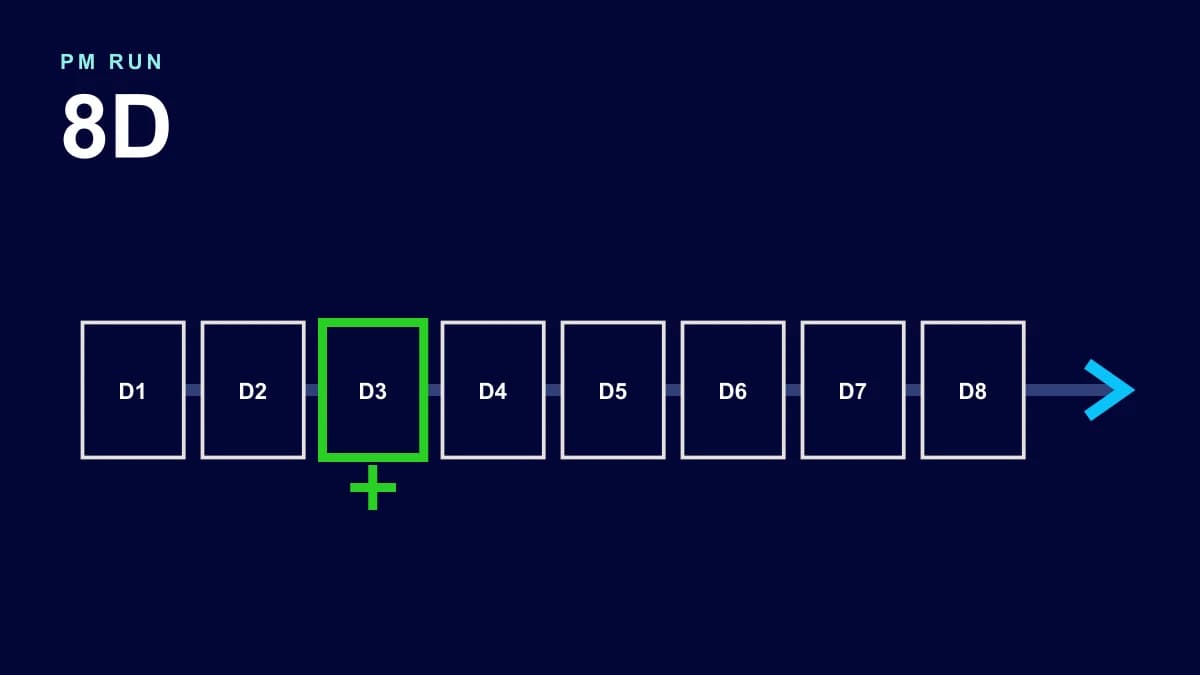
Eight Disciplines problem solving carries a significant issue from immediate protection through systemic prevention. Its maintenance value comes from keeping containment, occurrence cause, escape cause, permanent correction, and validation as distinct decisions with their own evidence.
The completed scenario opens when gearbox G-17 on a granulation line fails 36 hours after bearing replacement. Abrasive particles are found in the lubricant, while the redundant line has limited capacity. Assets, values, and findings are instructional and do not describe a PM Run customer or prescribe limits for another facility.
D0: prepare the emergency response
The first decision protects people, process, and comparable assets without destroying evidence. Operations isolates G-17 under the plant procedure. Maintenance preserves an oil sample, removed bearings, seals, wipes, packages, and opening photographs. Planning identifies recent work in the same family. Engineering decides whether severity and uncertainty warrant a full 8D.
Initial containment is not labeled as cause. Stopping sibling equipment, checking breathers, and blocking open lubricant containers are temporary barriers while the mechanism remains under investigation. Every barrier has an owner, scope, start time, release criterion, and residual risk. An action without removal logic easily becomes an undocumented standard.
D1: assemble competence and authority
The 8D leader controls decision checks and the reasoning record. A mechanic who performed the job reconstructs sequence and conditions without becoming a convenient culprit. Lubrication reviews transfer and storage, operations describes startup, reliability directs analysis, a laboratory examines debris, planning maps orders and exposure, procurement checks packaging, and SAP specialists protect traceability.
The group needs decision rights as well as knowledge. The sponsor removes obstacles and resolves conflicts between production recovery and evidence preservation. The technical owner may refuse release while acceptance evidence is incomplete. A long invitation list cannot substitute for explicit roles.
| Role | Verifiable output | Decision authority |
|---|---|---|
| 8D leader | Discipline record, hypotheses, and decision status | Request evidence and keep a discipline open |
| Mechanical specialist | Bearing examination and physical mechanism | Recommend tests and assembly conditions |
| Lubrication owner | Handling chain, samples, and analysis | Block a contaminated route or vessel |
| Planner | Orders, exposed population, and schedule | Insert approved containment into feasible windows |
D2: describe the boundary of the problem
The approved statement reads: abrasive wear and high temperature at the G-17 output bearing, detected 36 hours after replacement, with mineral particles in the lubricant and a line shutdown. It gives object, mode, location, time, and consequence. It does not claim improper assembly because the investigation has not established that explanation.
An is and is not comparison narrows the field. The event is on G-17, at the output bearing, after night-shift work. It is not observed on G-16, at the input bearing, or after the three prior day-shift replacements. Those contrasts neither acquit nor condemn a person. They guide sampling of tools, containers, environment, breather, and sequence.
Magnitude remains one confirmed event, one affected gearbox, and four assets potentially exposed through the same lubrication route. Records without contaminant analysis remain suspected rather than counted. This language prevents text similarity across notifications from inventing a larger population.
D3: contain the risk while preserving learning
Temporary actions include inspection of four gearboxes, oil sampling before any top-up, segregation of open workshop containers, and use of a verified dedicated filtration unit. Production runs the redundant line within its approved operating envelope. Temperature or noise beyond the internal criterion triggers evaluation instead of continued operation for schedule convenience.
Each inspection uses the appropriate order or operation, with result, time, owner, and relationship to the 8D. A crisis spreadsheet may coordinate activity but cannot replace the asset record. Containment is removed only after the permanent correction proves effective and the exposed population receives a disposition.
The daily review asks whether every plausible object is covered, the barrier was executed correctly, another risk was introduced, and the barrier remains necessary. A negative answer creates a defined action. A completed status does not prove that sampling preceded replenishment.
D4: establish occurrence and escape causes
Examination finds silica particles consistent with local dust and abrasive marks on the bearing. The team reconstructs lubricant transfer. An uncovered intermediate vessel stood near the bench during compressed-air cleaning. A bottom sample from that vessel contains similar particles. Physical compatibility, comparison, and route reconstruction support the occurrence cause: contaminant entered during intermediate handling.
The escape cause sits elsewhere. The instruction required clean lubricant but did not specify a closed dedicated vessel, visual check, verified filtration-unit identity, or release sample. The task list combined lubrication and assembly in one operation. Acceptance checked completion and quantity without evidence capable of finding contamination before startup.
Alternatives receive direct tests. Sealed packages from the same batch pass sampling, the gearbox breather is intact, assembly grease lacks the contaminant, and recorded alignment and clearances meet their criteria. These findings do not prove that every aspect of work was perfect. They reduce competing explanations for this specific mechanism.
| Cause layer | Question | Case evidence |
|---|---|---|
| Occurrence | How did particles reach the bearing? | Open vessel, compatible samples, reconstructed route |
| Escape | Why did the process release the condition? | No physical barrier and no detecting acceptance step |
| Systemic exposure | Where can the same process design exist? | Other task lists with lubrication embedded in broad operations |
D5: select permanent corrective actions
Each cause becomes a control requirement. Occurrence is addressed through closed, identified, dedicated transfer containers with protected storage and controlled cleaning. Escape is addressed by separating preparation, lubrication, and release operations, requiring identity confirmation and a sample where criticality rules demand one.
A decision matrix weighs control of the mechanism, implementation risk, verifiability, window impact, and reliance on behavior. Training alone ranks below a physical route that makes deviation visible. Disciplinary action cannot repair an instruction and acceptance design that allowed unsuitable containers.
Maintenance rehearses the sequence in the workshop, safety reviews handling and ergonomics, procurement confirms container availability, and planning measures duration. The rehearsal shows that the original identification label releases when oily. The team changes label material before the field pilot, avoiding a barrier that exists only in documentation.
D6: implement and validate under exposure
The permanent action is piloted on G-16 during scheduled work. Its order separates cleaning, transfer, filling, sampling, and release. Permitted photographs show the closed identified container, laboratory results are associated, and confirmation records performer and time. A deviation blocks startup until technical disposition.
Validation operates at two levels. Implementation review confirms that every operation occurred, the sample met the criterion, and chain of custody is complete. For this instructional case, the internal laboratory used no more than 15 mg/kg of silica particles in the investigated class, under the same analytical method, as its release criterion. This number belongs only to the scenario and is not a manufacturer limit, industry reference, or reusable specification.
Effectiveness then follows each gearbox for at least 600 operating hours, with samples at 100, 300, and 600 hours plus bearing inspection. The release sample is assessed before startup. Once equipment is operating, a result above 15 mg/kg activates the technical owner's response, such as restricting load or stopping according to risk, reviewing the handling chain, and reapplying containment to the related population. This post-start threshold drives an operational reaction and does not retroactively block a release that already occurred.
Release samples from the pilot and two later interventions measured 4, 6, and 5 mg/kg. All three gearboxes completed 600 hours, and intermediate samples stayed below 15 mg/kg without an upward sequence. None repeated the abrasive mechanism during that exposure. The 8D reports these three opportunities and their values directly without converting them into a reliability percentage or future guarantee.
D7: prevent recurrence through horizontal review
Prevention searches for the same process design rather than the same asset name. The team queries task lists where lubrication sits inside broad operations, workshops using intermediate vessels, families sharing transfer equipment, and exposed storage points. Each candidate receives a technical review before the solution is copied.
Approved task lists are versioned, qualification uses practical demonstration, receiving checks package integrity, and audits sample identification, closure, and evidence. Preventive strategy or frequency changes remain under engineering governance in SAP PM. The 8D supplies requirements and learning rather than automatic authority to redesign plans.
The escape finding also changes operation design in selected orders. Separating critical checks helps field staff confirm condition and lets acceptance locate responsibility. A generic paragraph copied into every order would reduce usability and create paper compliance.
D8: close responsibility, recognition, and residual risk
The final record includes the verified problem statement, containment reach, causal evidence, occurrence and escape actions, pilot results, extended population, residual risk, and control owners. Recognition is tied to concrete contributions such as preserving components, reconstructing work honestly, and challenging weak hypotheses.
Containment ends by object and date, not through a broad sentence. Samples and parts receive disposition under local procedure. Items beyond scope become owned actions rather than keeping the 8D artificially open. A defined owner reopens the record if the same mechanism returns.
Connect disciplines to SAP PM history
The first notification preserves symptom, consequence, time, and object. An emergency order records inspection and repair. Containment orders cover the exposed population. A pilot order implements permanent correction. Confirmations show execution, documents preserve samples and acceptance, and the task list receives the validated version.
Relationships among those objects prevent history from appearing as repeated bearing replacements without context. Damage, cause, and activity codes follow the organization's approved catalog. The controlled 8D record carries causal reasoning and points to evidence rather than replacing operational records.
Use the Five Whys guide to sharpen questions and root cause analysis in maintenance for deeper mechanisms. For order design, review the maintenance work order template.
Audit criteria for a credible 8D
- Containment covers the plausibly exposed population and has a removal rule.
- The problem description reports observations without anticipating blame or solution.
- The occurrence cause explains a physical mechanism with direct evidence.
- The escape cause explains why existing controls missed the condition.
- Permanent actions map to different causes and have separate owners.
- Implementation and effectiveness are reviewed at different times.
- Horizontal deployment searches similar processes, not matching equipment names alone.
- History leads back from the decision to the order, sample, and instruction version.
PM Run participation
PM Run supports planning, mobility, and execution over SAP PM. Planning can organize capacity, shifts, skills, scheduling, and containment orders integrated with SAP. Mobility can return evidence and confirmations associated with performed operations. SAP retains technical objects and the official history.
Human authorities still isolate equipment, accept a sample, determine causes, release operation, and alter standard work. PM Run does not supply sensors, predictive AI, or an engine that completes 8D autonomously. Automated data may feed customer-built analytics without implying a ready-made analytical view.
Questions that change the 8D path
When is a shorter response enough?
A simple low-risk event with a known mechanism may use the local correction process. A formal 8D earns its effort when containment, cross-functional authority, validation, and systemic prevention need explicit decision checks.
Can training be a corrective action?
Training can support a specific demonstrable competency. In this case, the vessel and acceptance design also enabled the failure. Training without those physical and process changes would leave occurrence and escape available.
What happens to an unproven cause?
It stays a hypothesis with a pending test or documented reason for closure. The report does not promote it to probable cause simply to complete a discipline. If uncertainty prevents safe correction, containment remains or scope changes.
Can one work order hold the entire 8D?
The order carries executable work, resources, criteria, and confirmations. Investigation logic, hypothesis comparison, and discipline decisions belong in the controlled 8D record linked to the necessary operational objects.
What proves that containment remains effective?
The containment owner samples execution at the point of use, compares the covered population with the latest exposure list, and checks whether the barrier changes detection or merely records activity. Any missed asset, late sample, or unavailable dedicated vessel becomes a containment deviation with immediate disposition. This review prevents the emergency measure from becoming a reassuring status that no longer protects the operation.
Technical sources
- ASQ, Eight Disciplines 8D, reference for containment, causal layers, correction, and prevention.
- SAP Help Portal, Maintenance Order, official order documentation.
- SAP Help Portal, Confirmations, official execution-record reference.