Back
Manutenção Industrial

5S in Maintenance: Workshop Case and Audit

P
PM Run Team
August 23, 2026

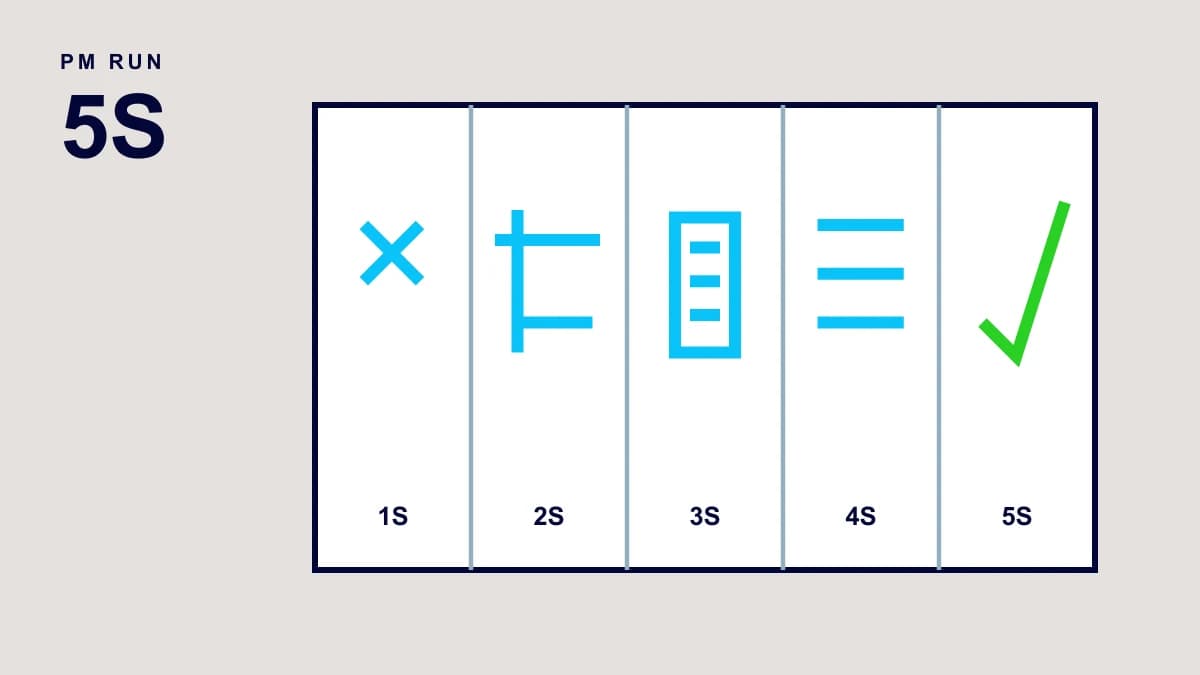
5S structures sorting, setting in order, cleaning with inspection, standardization, and discipline. In maintenance it reduces searching, duplication, contamination, and the risk of using a tool or instrument with unknown condition. The deliverable is a controlled workplace, not a clean photograph.

In the Line 2 central tool room, 5S must protect technical condition and response time rather than visual appearance alone. Sorting separates disposal, quarantine, and operational need; setting in order respects frequency and simultaneous demand; sustaining is tested on every shift and after emergency returns.

When 5S in Maintenance is the right tool

5S fits a workshop that loses search time, mixes serviceable resources with unknown condition, accumulates ownerless items, and cannot sustain location or return routines across shifts. The initial boundary selects a physical zone, resource families, shifts, and work orders that represent actual use.

A cleanup event, painted markings, and disposal without technical review create appearance without controlling readiness. Sustainment begins when red-tagged items have dispositions, quarantine has owners and dates, locations work during urgent orders, and audits confirm use for ninety days.

Evidence required before the first red tag

  • Usage flow: sampled orders, tool families, shifts, emergency issues, and the return sequence.
  • Current map: each resource location, walking distance, weight, ergonomics, access, and point of use.
  • Technical condition: identification, calibration, preservation, validity, known defects, and unconfirmed condition.
  • Simultaneous demand: quantity required per window, sharing across areas, shortages, and parallel kits already used.
  • Disposition authority: accountable roles for release, repair, calibration, transfer, disposal, and standard-quantity review.

If shift-level search, issue, return, calibration, or simultaneous demand lacks a source, the item remains visible in the baseline and no quantity is removed through estimation. A red tag opens a disposition decision; it does not authorize disposal.

Maintenance application steps

StageTechnical workRequired outputSAP PM handoff
Seiri, sortSeparate necessary, unnecessary, technical-quarantine, and unknown-condition items. Do not discard by appearance.Inventory with destination, owner, and deadline.Materials tied to orders and reservations retain traceability.
Seiton, set in orderDefine locations by frequency, criticality, ergonomics, and issue-return flow.Location map, identification, and standard quantity.Physical location complements the official material record.
Seiso, clean and inspectUse cleaning to expose damage, contamination, leaks, broken cables, and missing parts.Anomaly list with treatment route.Asset defects generate the appropriate notification or order.
Seiketsu, standardizeCreate a visual standard, condition rule, return sequence, audit, and response to deviation.Approved standard for every shift.Controlled documents change when the operating flow changes.
Shitsuke, sustainTrain, audit actual use, remove obstacles, and correct a standard that fails in practice.Audit, action, and verification routine.Indicators connect 5S to work-order readiness rather than appearance alone.

Each output follows its own controlled route. Unknown condition enters the quarantine board; overdue instruments follow calibration control; an asset anomaly found through cleaning creates a notification; approved locations and quantities enter the tool-room standard and shift handover. A task list changes only when the maintenance method also changes under the required technical approval.

Complete industrial case: reorganizing the Line 2 central tool room

Every person, asset, duration, quantity, and outcome in the Line 2 central tool room is didactic. The values demonstrate a completed 5S application without representing a PM Run customer, industry reference, regulatory threshold, or performance promise. A plant reusing the structure must replace its scales and criteria.

The tool room supports mechanical and electrical work in three areas. A didactic sample of 40 work orders found 28 minutes of average search time, duplicate kits, overdue-calibration instruments, and returns with no condition record.

Case baseline

DataDidactic valueInterpretation
Average search time per order28 minDidactic observation across 40 orders
Duplicate kits12Different teams built kits for the same job
Overdue-calibration instruments7Segregated before use
Eligible orders with a recorded tool return14/40 eligible orders (35%)Previous 30-day window under the same definition used for verification

Case target: reduce average search time below 10 minutes, segregate every instrument without valid condition, remove duplication without losing availability, and sustain the standard for 90 days.

Validation uses the baseline definition of search time, from starting the search through locating, issuing, and confirming resource condition. The sample covers all three shifts and planned, corrective, and urgent orders. Closure requires average search below ten minutes, continued segregation of every invalid condition, and no emergency loss of availability throughout the 90-day window.

Decision produced by the method

The team removed five duplicate kits, retained four for simultaneous demand, and quarantined three pending condition review. Overdue instruments were segregated. Locations followed the highest-frequency job flow, and every condition deviation received an identified treatment route.

The final board shows four active kits in approved locations, five completed duplicate dispositions, and three quarantined sets with owners, dates, and release criteria. A set returns to use only after competent acceptance, and a new location becomes standard only after it works on all three shifts and during an urgent issue. Planning prepares orders against that demonstrated availability.

Indicator and verification window

Primary indicator: search minutes per work order, supported by calibration compliance, recorded return, and repeated out-of-location items.

Case calculation: Average search time = total observed search minutes ÷ sampled work orders.

Window: weekly audit in month one, biweekly through D+90, and redesign whenever job mix, team, or layout changes.

Results after 90 days

For this comparison, “recorded return” uses the same definition in all three windows. An eligible order is a work order completed inside the window that recorded the issue of at least one controlled tool or instrument. It enters the numerator only when every resource issued for that order has its physical return, condition, and accountable person recorded in the official control before work-order closure. The denominator counts eligible completed work orders, not individual tools. At baseline, 14 of 40 eligible orders completed in the previous 30 days met the rule, or 35%. At D+30, 44 of 50 eligible orders completed on Days 1 to 30 met it, or 88%. At D+90, 48 of 50 eligible orders completed on Days 61 to 90 met it, or 96%.

MeasureBaselineD+30D+90Decision
Average search time per order28 min9.6 min8.4 minTarget below 10 min achieved
Instruments and sets without valid condition segregated10 identified exceptions10 of 1010 of 10100% segregated before any release
Eligible orders with a recorded tool return14/40 eligible orders in the previous 30 days (35%)44/50 eligible orders on Days 1 to 30 (88%)48/50 eligible orders on Days 61 to 90 (96%)Continue correcting shift-specific exceptions

Sustainment was verified through eight audits, four weekly and four biweekly, covering all three shifts, planned and corrective orders, and four emergency issues. Search time remained below ten minutes at D+30, D+60, and D+90. The seven overdue-calibration instruments and three unknown-condition sets remained segregated until a documented technical disposition. Every emergency issue had its expected resource available. With all three criteria sustained for 90 days, the owner retained the layout, quantities, and return routine, with a new review triggered by a change in work-order mix.

Limits and neighboring methods

Limits: 5S does not replace inventory management, calibration, safety, autonomous maintenance, or planning. Technical disposal requires competent approval. A tidy space may still create waiting when locations and quantities ignore actual work.

Neighboring methods: TPM uses 5S as a foundation, autonomous maintenance addresses basic equipment care, and Poka Yoke prevents a specific error. 5S owns workplace resources and sustained standard.

Method selection follows the question raised by the Line 2 central tool room. TPM organizes the system, autonomous maintenance cares for equipment, and Poka Yoke blocks a specific error. 5S delivers locations, quarantine, quantities, and a return routine that survives shift changes; TPM, autonomous maintenance, or Poka Yoke takes only the technical problem beyond that boundary.

Five 5S practices tied to technical condition and shift work

Seiri sends every item to one of four destinations: required, approved surplus, technical quarantine, or unknown condition. An overdue instrument is neither discarded nor returned to service. Duplicate kits stay until simultaneous work-order demand is checked.

Seiton uses frequency, weight, ergonomics, criticality, and issue-return sequence. Forty sampled orders reveal which resources belong near preparation. Emergency items receive controlled access that works on night shift rather than only during a daytime audit.

Seiso uses cleaning to expose corrosion, damaged cables, leakage, and missing components. An asset defect becomes a notification; a support-resource problem follows its condition route. Appearance is secondary to early anomaly visibility.

Seiketsu defines quantity, address, condition, withdrawal, return, and response to deviation. The standard is tested with gloves, low light, and emergency use. Shitsuke audits actual use and removes obstacles instead of blaming technicians for an impractical layout.

Sampled orders show demand. Materials and reservations retain their governance. PM Run can connect scheduling needs with field completion that triggers return routines. It does not autonomously manage inventory, approve disposal, or certify calibration.

The ninety-day review checks search time by shift, calibration compliance, emergency availability, and the destination of quarantined sets. Another workshop receives its own observation; copying colors and addresses would reproduce appearance without reproducing performance.

  • Did four kits cover simultaneous demand?
  • Did quarantine prevent use of overdue instruments?
  • Did emergency issues return to their addresses?
  • Was any required resource removed by mistake?

From red tag to sustained routine

A sample from the maintenance planning flow shows which kits, instruments, and resources belong near job preparation. Order frequency, simultaneous demand, weight, and urgency guide location and quantity.

The red tag retains identification, condition, owner, and disposition. Repair, calibration, transfer, and disposal follow their own approvals. When Seiso exposes a defect on maintained equipment, the finding enters a maintenance notification or order on the correct object.

PM Run Mobility can return execution notes and evidence over SAP PM. Material master data, physical location, calibration, goods issue, and quarantine release remain under the organization's accountable processes.

The ninety-day audit combines search, issue, return, missing-kit events, and quarantine age. Expansion to another workshop starts with its orders and constraints instead of copying quantities or locations.

Additional control questions

Sustainment combines a short walk, sampled orders, and conversations with all three shifts. The reviewer looks for out-of-location resources, expired labels, ownerless quarantine, and a return route that fails during emergencies. Each finding changes either the standard or an observable routine.

Standard quantity is based on simultaneous demand, replenishment time, resource criticality, and demand variation. When those factors change, Seiketsu revises the number and Shitsuke verifies adoption instead of blaming people for following an obsolete rule.

Red-tag aging is tracked by destination, not by count alone. A large pile cleared through unreviewed disposal is worse than a smaller queue with technical ownership and due dates.

The handover between shifts samples open withdrawals and missing items. This exposes whether the workplace standard survives the moment when responsibility changes and urgent work competes for attention.

Final sampling includes planned and corrective work so the workplace is not optimized only for predictable routines. The team measures time to locate, issue, and return resources separately. Authorization delay does not count as search, which keeps the countermeasure tied to the correct loss.

Quarantine has an aging rule. Calibration review, repair, approved disposal, or return to service must occur by a defined date. An item that remains tagged indefinitely is evidence that Seiri stopped at visual separation and never completed technical disposition.

The tool-room owner maintains a disposition board for quarantine with due date, competent reviewer, and approved outcome. Calibration, repair, disposal, and return to service follow different evidence routes. Location audit uses actual issue and return transactions rather than staged photographs. It samples heavy resources, frequently used kits, rare critical tools, and items shared across areas. Shift handover names withdrawals still open and resources temporarily moved. If an emergency prevents immediate return, the temporary address and responsible person are visible. Management reviews search time together with missing-kit events, expired calibration, ergonomic deviation, and urgent-work performance. This balanced view protects technical readiness. A new workshop begins with its work mix, replenishment time, and constraints before adopting any quantity or layout.

The sustainment routine assigns one reviewer per zone and rotates a technician from another shift. They sample open withdrawals, quarantine age, calibration condition, and the first resource needed for a recent urgent order. A deviation is classified as unclear standard, unavailable resource, impractical return, or missed routine. That classification determines whether layout, quantity, process, or behavior changes. The audit never rewards moving an unknown-condition item out of sight. Disposition must be technically approved and traceable. Search-time improvement is normalized by sampled jobs and read with emergency availability. If the room looks cleaner but technicians create personal shadow kits, the official standard has failed and returns to Seiketsu.

Technical sources

Bring a real tool-room or workshop flow to a PM Run demonstration and see how order demand, capacity, execution, and return evidence remain connected to SAP PM.

5S
Maintenance Workshop
Tool Room
Visual Management
TPM
SAP PM
PM Run

Built for SAP.Not just adapted. Native.

PM Run connects planning, field execution, and supervision through native SAP integration, with no parallel spreadsheets, no re-entry at end of shift, and no data loss.

Used by leading operations in their sectors

Logo Volkswagen
Logo Eurofarma
Logo Saint-Gobain
Logo Marcopolo
Logo Moura
Logo Alpargatas

Back to blog