
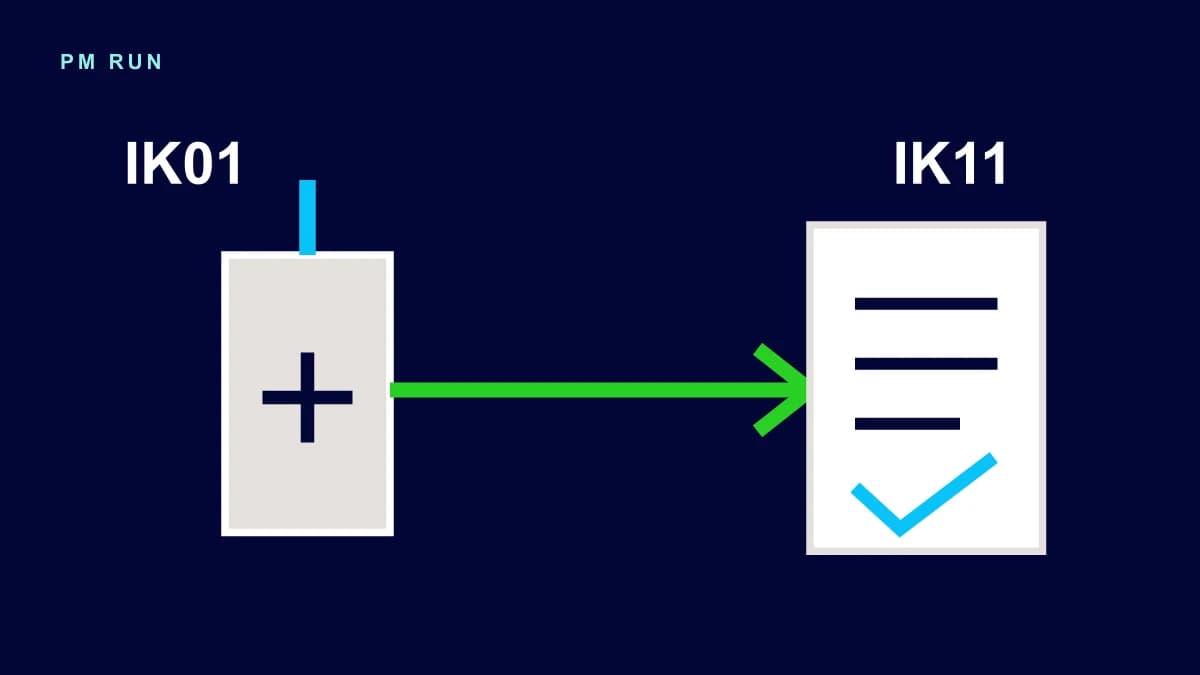
A measuring point defines what to observe. A measurement document records the observed value at a point in time. In SAP PM, IK01 creates the point and IK11 creates the document. Mixing those roles leads to inconsistent units, broken counters, readings on the wrong object, and action without evidence.
A reading supports condition-based maintenance only when the characteristic, unit, valid range, counter rule, frequency, owner, and response to deviation are defined. A number without context is stored data, not an operating decision.
A measurement document retains technical value when point, characteristic, unit, timestamp, instrument, owner, and exception stay connected. Mobile collection, a spreadsheet, or an integration may transport the reading when origin, validation, and return to SAP PM remain traceable.
The metrology chain from point to document
Before collection, the owner defines position, method, range, unit, operating condition, official document, and acceptance rule. The design also covers an unavailable instrument, invalid value, duplicate, cancellation, retry, and mismatch with the physical display.
The unit of work is each reading or valuation linked to the correct point and actual collection time. Control follows series coherence across point, unit, instrument, counter, limit, document, and action. One entry may look valid on screen while still breaking a trend or a maintenance call.
Characteristic, unit, counter, and reading
| Object or resource | Role in the process |
|---|---|
| IK01, IK02, and IK03 | Create, change, and display points or counters with object, characteristic, unit, and parameters. |
| IK11 | Creates the measurement document for routine readings and observed condition. |
| IK12 and IK13 | Change or display documents according to authorization and correction needs. |
| IK17 and IK18 | Support document lists and processing according to the environment. |
| Technical object | Equipment or functional location to which the series belongs. |
| Limit and valuation code | Contextualize quantitative readings or qualitative valuation and guide response. |
A replaced hour meter on compressor C-12
In an instructional scenario, compressor C-12 has an operating-hour counter and an overall bearing-vibration point configured in mm/s. After an instrument change, one file supplied displacement in µm for the velocity point. Because conversion between displacement and velocity depends on frequency and the measurement model, those rows were rejected and isolated for metrology review. The team did not correct them directly in Excel.
The old hour meter was also replaced after 18,742 hours, while the new device began at zero. A preventive order depended on accumulated performance. Without approved transition treatment, the series showed a decrease and made the next call uncertain. An above-limit vibration row remained isolated until unit, method, and response were confirmed.
The plant reviewed the C-12 object, position, unit, instrument, resolution, range, the frequency or model required for any valid conversion, counter rules, and replacement procedure. Technicians record actual date and time. An out-of-limit value follows the approved notification and priority rule. Each exception is reconciled across instrument, IK11 document, and resulting action.
How a reading becomes reliable history
The route has eight measurement-specific controls. SAP documentation for measuring points and counters and measurement documents defines the objects; parameters and transactions still require release-specific confirmation.
- 1. Point identity. Verify compressor C-12, physical position, point number, characteristic, and field marking before collection. Evidence compares master data with the asset label. An ambiguous point or mismatched object stops entry.
- 2. Quantity, unit, and method. Compare the configured unit with instrument output. Values in µm do not enter a mm/s point without documented frequency, model, and technical conversion. Incompatible rows remain rejected and isolated with the original file preserved.
- 3. Instrument and condition. Record instrument identity, range, resolution, metrology status, position, and operating regime. Acceptance requires all of them to meet the approved method. Missing evidence triggers recollection rather than an estimated value.
- 4. Counter continuity. Link the old meter's last document at 18,742 hours, the replacement order, and the new meter's first document. Transfer, offset, or restart follows tested configuration and authority. Field personnel do not edit a sheet to manufacture continuity.
- 5. Field collection. Capture value or code, actual date and time, user, source, and required observation. This dataset is the evidence before submission. A stale, duplicate, or misassigned reading stays outside posting.
- 6. SAP document. Retain the IK11 document number, message, point, accepted reading, and processing time. The response must prove creation on the expected point. Technical success without a document number or with a unit mismatch remains an exception.
- 7. Deviation response. Apply range, limit, and valuation under the point rule. When a notification is required, retain observed condition, priority, owner, and due time. A threshold cannot assign cause or impose one response on every characteristic.
- 8. Reconciliation and release. Compare instrument, documents, counter sequence, rejected rows, and resulting action. For a performance-based plan, also review the maintenance-call effect before releasing the new series. Every difference ends with an authorized correction or a formal open item.
Reading, replacement, and exception paths
| Path | When to use | When to reject | Minimum evidence |
|---|---|---|---|
| Quantitative point | Numeric value comparable over time | Changing unit or method | Series with defined unit, instrument, and range |
| Valuation code | Qualitative condition with controlled catalog | Free text without consistent meaning | Approved code, description, and response rule |
| Counter | Accumulated use supporting performance-based maintenance | Replacement or decrease without procedure | Reading, difference, replacement, and continuity treated |
| Out-of-limit reading | Technical rule with defined response | Alarm without owner or generic automatic action | Document, notification, priority, and treatment linked |
Ownership of master data and collection
Engineering defines characteristic, unit, position, range, method, and response to deviation. SAP holds points, counters, and documents. Execution identifies source, instrument, and time. Planning owns effects on plans and orders. An above-limit reading without an owner and due date is only an exceptional number in history.
Series continuity and maintenance calls
History becomes useful when another professional can reconstruct collection without relying on technician memory. This requires retaining technical object, point, characteristic, unit, position, value or code, date, time, source, user, counter, document, limit, and resulting action. An incomplete entry may close the daily routine while weakening trends, failure analysis, plan review, and audit defense.
The series must survive instrument change, counter replacement, unit change, and authorized correction. Retain original value, document, reason, next value, and resulting action. Editing a spreadsheet without treating the IK11 document creates two histories and compromises trends, performance calls, and audit.
Reconcile the SAP point with its physical instrument
Prepare eight controlled records for compressor C-12: three valid readings in mm/s, two incoming rows in µm, one repeated timestamp, one counter decrease, and one value above the configured limit. Inspect the point created through IK01 and allow IK11 entry only for records compatible with the characteristic, unit, instrument, and sequence. The result must retain both the accepted measurement document and the technical reason for every rejected row.
- Verification 1: IK01 point master. Assign the point to compressor C-12, the inspected physical position, and the velocity-vibration characteristic. Retain point number, mm/s unit, approved range, and counter indicator where relevant. Configuration is acceptable when a maintainer can identify the corresponding bearing and axis before taking a reading.
- Verification 2: metrology match. Compare instrument label, calibration validity, resolution, range, method, and measurement direction with the instruction attached to the point. An identified photograph and calibration record provide the evidence, rather than a general note saying the device was available. The instrument qualifies only if it measures the defined quantity and span without an improvised unit change.
- Verification 3: separation of mm/s and µm. Submit the two displacement rows alongside the three velocity readings. Keep the µm values rejected or in a separate population with a reason code because conversion requires frequency, model, and documented assumptions. A spreadsheet must not turn those entries into mm/s until a technically valid conversion has been established.
- Verification 4: normal document through IK11. Post one eligible reading with point, value, inherited unit, date, time, and collector. Evidence pairs the measurement-document number with its identified source row. Entry passes when document retrieval reproduces the observed value and instant without rounding that changes its evaluation.
- Verification 5: duplicate instant. Present the same point, timestamp, and collection identifier twice. Before another posting, locate the existing document and compare the source to distinguish retransmission from a genuine second observation. The exercise must leave one document for the repeated occurrence and an explicit hold if the two values disagree.
- Verification 6: limit and valuation. Use one value below the threshold, one exactly at it, and another above it within instrument precision. Capture the resulting valuation and the plant-defined response, which may involve review, a notification, or no automatic creation under the configuration. Passing means every reading follows the approved rule and the high case reaches its owner without assuming a universal SAP action.
- Verification 7: counter replacement. In the instructional scenario, close the former meter at 18,742 hours and commission the replacement at zero through the configured change procedure. Retain both point or device identifiers, final document, commissioning reading, replacement date, and reason. Continuity is proven when historical value remains untouched and subsequent consumption uses the difference from the correct counter.
- Verification 8: decrease and possible overflow. Submit a reading below its predecessor in two contexts: without justification and with documented overflow or replacement. Preserve the functional message, source row, and handling applied to each case. The test passes when the lower value follows the approved overflow or replacement configuration without erasing the series, while a reduction without valid cause is blocked or routed for exception review.
- Verification 9: correction of a faulty observation. For a document created from a collection error, follow the environment's approved correction or cancellation route instead of overwriting the source. Connect the original document, owner's disposition, any cancellation, and the replacement document. The trail must support recalculating the series from valid documents while revealing that the earlier posting occurred.
- Verification 10: impact on a performance-based plan. Compare the next-call forecast before and after the accepted reading, recognizing that the plan uses counter differences and cycle configuration. Also simulate the move from 18,742 to zero with the approved continuity link. Acceptance requires no artificial acceleration or delay and a calculation explainable from the measurement documents used.
Mobile collection tied to the SAP object
PM Run Mobility can present measuring points and record measurement documents tied to equipment or functional location through the integrated SAP PM flow. Point, unit, limit, instrument, and response rule remain defined in SAP and by plant engineering.
Architectural distinction: PM Run was built to operate as a layer connected to SAP PM. Its flows respect SAP objects, rules, configuration, authorizations, and validations.
In this process, PM Run provides a mobility and execution layer over SAP PM, which remains the system of record. The documented product does not acquire sensor data, predict failure, or define instrumentation, limits, and technical decisions.
Continue the technical path: industrial preventive maintenance, execution data and MTBF, asset management in SAP, mobility integrated with SAP PM.
Preserve series continuity after meter replacement
In the same instructional scenario, compressor C-12 accumulates operating hours on a local meter. During an outage, the display fails and the instrument is replaced. The old device shows 18,742 hours at its last trustworthy reading, while the new meter begins at zero. A first document without context could make later analysis interpret the drop as error, cycle reset, or negative operation.
Before replacement, the owner identifies measuring point, unit, physical position, characteristic, and latest accepted document. The team photographs the reading where policy allows, records the work order that caused replacement, and preserves serial identity when applicable. Removal confirms whether the display is still legible. A disagreement between the device and SAP history becomes an exception rather than a silent adjustment.
Point master data must represent whether the characteristic behaves as a counter and how continuity will be handled. Counter parameters, reading transfer, or instrument replacement follow the approved SAP configuration and procedure. A field technician does not invent an offset to make a graph appear continuous. Master-data authority documents the decision and tests behavior before routine collection resumes.
The first document from the new instrument
The initial reading carries coherent date and time, correct unit, instrument identification, and reference to the replacement event. An observed value stays distinct from any calculated reading. If estimation or transfer is part of the controlled process, its source and rule remain visible. A reviewer should understand the transition without relying on outage participants.
A second reading soon after startup tests direction, chronology, and plausible increment. A lower value, backdated entry, or incompatible jump triggers review under governance. The owner may compare operation time with the counter while acknowledging that the two sources can represent different concepts.
When the point feeds a performance-based plan, the accepted increment between current and previous readings, treated under the configured transfer or replacement rule, updates exposure against the cycle. Cycle settings, estimated performance, and scheduling parameters determine the projected call under approved configuration. The team therefore checks both the reading difference and future-call effect before releasing the new series. Strategy and frequency remain engineering decisions in SAP PM.
Audit characteristic and unit at the field location
The team samples hour, temperature, and pressure points because they need different controls. It verifies unit, range, decimal treatment, position, method, and instrument against reality. A temperature in the wrong unit may pass a presence check. A counter reading can look valid alone while breaking the sequence.
The exception report prioritizes duplicate timestamps, regression, jumps, out-of-window documents, entries on inactive points, and narratives that contradict values. Each rule has an approved tolerance and disposition owner. An alert cannot correct a reading automatically because physical condition may have changed.
What the C-12 history must retain
The transition links the replacement order, last old-meter document, first new-meter document, and continuity decision. Future queries can distinguish raw hours on the new device from accumulated exposure used by engineering. Observed fact and authorized transformation remain separate.
Validation follows three collection cycles. Acceptance requires chronological order, correct unit, no duplicate, and ability to reproduce collection at the defined position. A failed point returns for master-data or instruction review instead of accumulating documents for a future cleanup.
Technical sources
The technical references delimit point master data, document creation, and counter treatment. Characteristic, limits, unit, and counter treatment require validation in the system configured for the organization.
Frequently asked questions
What is the difference between a point and a measurement document?
The point defines what and where to observe and in which unit. The document records a reading or valuation at a time for that point.
How should counter replacement be treated?
Follow the approved replacement, transfer, and continuity procedure. Retain previous reading, new reference, date, owner, and effect on the calculated difference.
Should an out-of-limit reading create an order automatically?
Only when an approved technical rule defines that flow. Response may be a notification, inspection, reading confirmation, or another decision. A limit alone does not define priority.
What proves an IK11 reading?
Point, object, value or code, unit, date, time, user, source, document number, and treatment of every message or exception.
Does PM Run provide sensors or predictive AI?
PM Run Mobility supports integrated consultation and recording of measurements. Automatic sensor acquisition and prediction are outside that documented scope.