
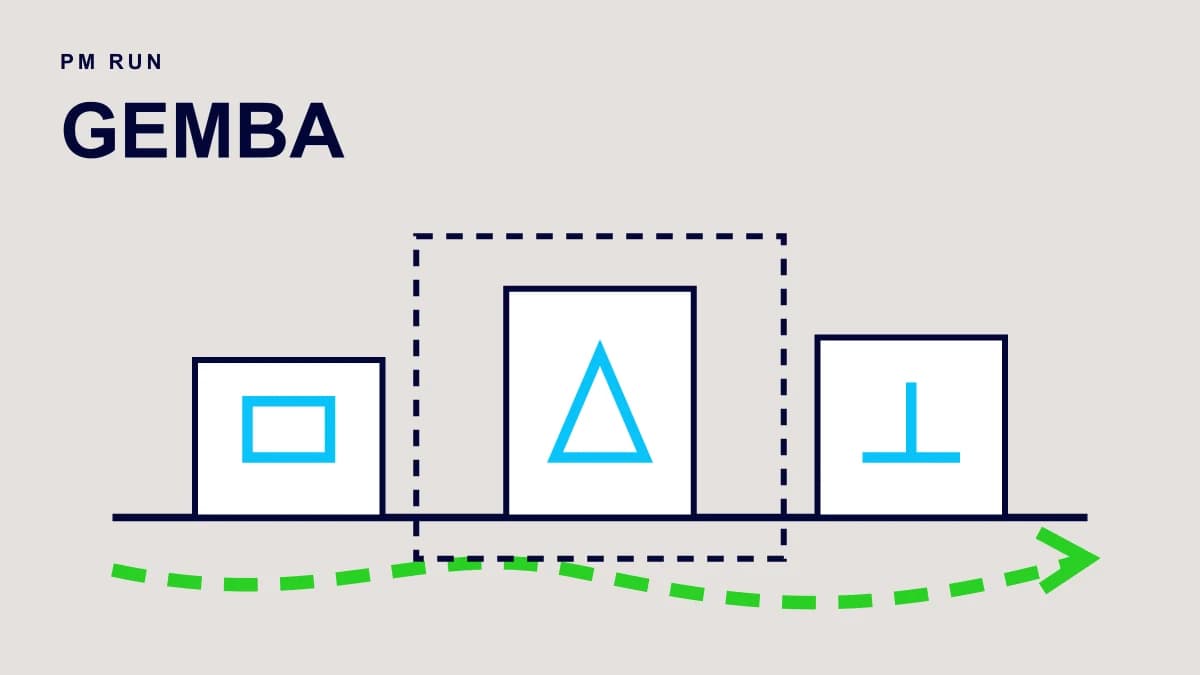
Gemba is the place where work and value happen. A maintenance Gemba walk observes actual flow with respect for the people doing the job, checks conditions, and asks questions. It is not a surprise inspection of individuals.
The EX-08 bearing-replacement Gemba observes work as it happens, with access, waiting, tools, sequence, communication, and risk visible. The walk has a defined question, is not a policing visit, and ends with facts that change the plan, kit, or release only after validation with the people doing the work.
When Gemba Walk in Maintenance is the right tool
Gemba fits work whose total duration or delay is known while management still cannot see which wait, movement, release, or information handoff separates actual flow from the plan. The observation question bounds one normal intervention, its shift, safe observation points, and the decision that evidence may change.
Arriving with a fixed solution, rating individuals, or interrupting a critical step distorts the evidence. The walk produces a result when technicians validate the timeline, a countermeasure preserves technical controls, and repetition in comparable interventions confirms the effect.
Preparing an observation that represents actual flow
- Focused question: work segment whose waiting, sequence, or handoff needs explanation.
- Planned reference: order, operations, task list, kit, access, release, and controls expected to guide execution.
- Time marks: start and finish of waiting, travel, searching, technical activity, inspection, and return.
- Interference map: simultaneous work, Operations, permits, late information, support, and condition changes.
- Observation agreement: participants, privacy, safe moments for questions, and stop authority.
If timing, condition, or the origin of a wait cannot be confirmed, the timeline records the evidence gap. An occurrence changed by observer presence cannot support a route revision and requires another representative observation.
Maintenance application steps
| Stage | Technical work | Required output | SAP PM handoff |
|---|---|---|---|
| Prepare the question | Define the flow, available data, and safety and privacy boundaries. | Observation plan, observers, and operating agreement. | The order and schedule provide scope, operations, resources, and expected time. |
| Observe without interrupting | Record sequence, waiting, travel, searching, decisions, rework, and handoffs with time and context. | Factual timeline. | Evidence remains within company privacy and safety policy. |
| Ask respectfully | After a safe step, ask technicians to explain obstacles, criteria, and alternatives. | Notes separating fact, interpretation, and hypothesis. | A technical finding may create a notification, while Gemba leaves diagnosis open. |
| Compare with the process | Contrast observed flow with the order, task list, material, capacity, and planned release. | Differences ranked by impact and recurrence. | Planning checks whether preparation represented actual need. |
| Convert to a decision | Select changes to kit, sequence, preparation, or recording through a pilot. | Countermeasure, owner, pilot order, and indicator. | PM Run Planning supports capacity, and Mobility returns field evidence to SAP PM. |
Gemba produces a chronology validated by the crew. The observation note remains linked to the observed order; a new technical defect creates a notification; the countermeasure becomes an identifiable operation in the pilot order; the task list incorporates only a repeated and accepted change whose mechanism is documented.
Complete industrial case: planned bearing replacement on exhaust fan EX-08
Every person, asset, duration, quantity, and outcome in the EX-08 bearing replacement is didactic. The values demonstrate a completed Gemba application without representing a PM Run customer, industry reference, regulatory threshold, or performance promise. A plant reusing the structure must replace its scales and criteria.
The replacement was scheduled for 7.0 hours and took 11.5 hours. The report said maintenance delay. The Gemba was prepared for the next equivalent intervention without interfering with safety or turning observers into technician inspectors.
Case baseline
| Data | Didactic value | Interpretation |
|---|---|---|
| Planned duration | 7.0 h | Included isolation, removal, replacement, assembly, and test |
| Previous actual duration | 11.5 h | A 4.5-hour gap |
| Waiting for release | 1.4 h | Condition that should have been resolved before the window |
| Completing the kit and finding the tool | 1.1 h | Work-package readiness failure |
Baseline reconciliation: the losses are 1.4 h waiting for release, 1.1 h completing the kit and finding the tool, 0.7 h for travel and access, 0.8 h for scope clarification, and 0.5 h for support coordination. The sum is 1.4 + 1.1 + 0.7 + 0.8 + 0.5 = 4.5 h; 7.0 technical hours + 4.5 h of losses = 11.5 actual hours. Each interval receives its own timestamp without double counting.
Case target: complete the comparable intervention in no more than seven hours without compressing safety controls, with a complete kit, released access, and elapsed-time evidence by stage.
The comparison accepts only orders with the same bearing, technical scope, access condition, release criterion, and dimensional inspection. Waiting, travel, and execution receive separate timestamps. An atypical intervention cannot revise the bill of material, and any reduction obtained by removing an inspection or safety barrier fails the test.
Decision produced by the method
The observation showed that technician skill was not the main loss. Waiting for release, completing the kit and finding the tool, and travel for access explained 3.2 of the 4.5 added hours. The team created a bill-of-material kit, a D-1 readiness gate, and a shared release sequence. Technical steps were not compressed.
Reconciling the 4.5-hour gap
| Observed stage | Duration | Interpretation |
|---|---|---|
| Waiting for release | 1.4 h | Condition that should have been resolved before the window |
| Completing the kit and finding the tool | 1.1 h | Work-package readiness failure |
| Travel and access | 0.7 h | Resource and access prepared late |
| Scope clarification | 0.8 h | Difference between the order and field condition |
| Support coordination | 0.5 h | Support responsibility lacked a readiness gate |
| Technical bearing replacement | 5.8 h | Technical sequence preserved |
| Dimensional inspection, assembly, and return | 1.2 h | Technical control preserved |
| Total | 11.5 h | 7.0 technical hours plus a 4.5-hour gap |
Release, kit completion with tool retrieval, and travel account for 1.4 + 1.1 + 0.7 = 3.2 h. Scope clarification and support coordination account for 0.8 + 0.5 = 1.3 h. Therefore, 3.2 + 1.3 = 4.5 h of losses and 7.0 + 4.5 = 11.5 h observed. The reconciliation does not attribute the difference to technician speed.
The walk selects two countermeasures: pre-stage the puller and advance the release. Dimensional inspection remains a technical control. The record assigns an owner and mechanism to each wait, and three comparable orders verify whether those changes produced the reduction. A change in access, scope, or asset condition requires another observation.
Indicator and verification window
Primary indicator: controllable waiting time per order, classified as material, access, information, tool, and decision.
Case calculation: Controllable waiting percentage = classified waiting time ÷ total observed duration × 100.
Window: compare three equivalent interventions within 90 days, review each observation on D+1, and decide after sufficient exposure.
Three comparable interventions
| Intervention | Total duration | Controllable waiting | Dimensional inspection | Result |
|---|---|---|---|---|
| D+28 | 6.9 h | 0.3 h | Completed and accepted | Target achieved |
| D+57 | 6.7 h | 0.2 h | Completed and accepted | Target achieved |
| D+84 | 6.8 h | 0.2 h | Completed and accepted | Target achieved |
All three orders used the same bearing, scope, release criterion, and inspection method. A complete kit and released access were evidenced at the D-1 gate. Because no reduction came from removing technical controls, the 90-day review retained the bill-of-material kit, readiness gate, and shared release sequence. Any change in scope, access, or asset condition still triggers a new observation.
Limits and neighboring methods
Limits: Gemba does not replace formal audit, causal investigation, or statistical measurement. One observation does not represent all shifts. Observers must not induce unsafe behavior or use the method to judge individuals.
Neighboring methods: Wrench time quantifies time use, Kaizen tests improvements, 5S treats the workplace, and PDCA governs verification. Gemba owns direct evidence of actual flow.
Method selection follows the question raised by the EX-08 bearing replacement. Value-stream mapping widens the view, time study measures repetition, and Kaizen tests the change. Gemba turns differences between planned route and actual execution into facts validated with the crew; time study or Kaizen follows when repetition must be measured or an approved change tested.
Observation, dialogue, and a test on the next intervention
The EX-08 question is where the planned route differs from actual work. The observer reads mandatory controls and agrees that the walk will not rate individual performance. A normal intervention is observed without extra resources staged for the visit.
The timeline separates release waiting, travel, tool search, disassembly, dimensional inspection, and assembly. “The technician walked to the workshop twice” is a fact. “The crew is disorganized” is judgment. “Pre-stage the puller” is a proposal.
Technicians explain expected variation and why the route fails. They confirm that earlier release can reduce waiting, while dimensional inspection cannot be removed. The countermeasure emerges from this dialogue rather than from a photograph.
The next comparable intervention receives the puller in its kit and an earlier release request. Waiting, travel, and technical duration are compared across three jobs. A short duration caused by an atypical found condition does not justify task-list revision.
The observed order, operation confirmations, time, and deviation note preserve evidence. Planning compares route and capacity; Mobility returns field notes and allowed attachments to SAP PM. The task list changes only after approval.
Gemba is repeated when access, scope, crew, or equipment changes. PM Run does not conduct the walk or classify behavior. Automated data can support customer-built waiting analysis only when the observation context remains accessible.
- Were facts validated with technicians?
- Did the proposal preserve safety and quality?
- Was the pattern seen in more than one intervention?
- Did waiting fall without moving to Operations?
From timeline to pilot order
A validated fact enters planning governance with the wait's start, finish, condition, and accountable owner. The next maintenance order receives separate operations for kit readiness and release without removing dimensional inspection.
PM Run Planning can compare duration, capacity, and outage window while field records return actual timing to SAP PM. Operations waiting remains separate from tool search because their countermeasures have different owners.
After each comparable intervention, technicians validate the chronology and explain interference. The revised task enters the task list after repetition confirms the mechanism; a new condition reopens observation instead of inheriting the earlier conclusion.
Additional control questions
The observation sheet records timestamp and location. Every wait has a start, finish, observed cause, and person able to explain context. The observer avoids reconstructing duration later because memory compresses routine work and exaggerates frustrating moments.
Post-walk review separates removable barrier, necessary control, and unavoidable variation. A distant puller is a barrier; dimensional inspection is a control; found condition may be variation. This classification protects quality while pursuing flow.
A second observer may sample one intervention to challenge interpretation, but technicians remain the primary source for why the sequence changed. Agreement is documented where fact and explanation converge.
Task-list revision includes the reason for every changed operation. If future crews face another condition, they can distinguish a deliberate control from legacy wording and open a new observation.
Waiting is paired with dimensional-inspection compliance and safety observations. This balancing view prevents a shorter job from being classified as better when time was saved by skipping a control. Every proposed removal names the purpose of the original step before it is tested.
The observation is closed only after technicians review the factual timeline. Disagreement is recorded with the missing evidence needed to resolve it. Management does not force consensus to produce a cleaner report, because unresolved variation may be the most important finding.
The walk plan defines the safe moments for questions, the observation boundary, and conditions that stop observation. If the crew changes behavior because of management presence, the record marks the job as nonrepresentative. The observer notes information arriving before each step, not only physical motion. Late release, unclear scope, and missing tool location may share the same visible wait but require different owners. After the job, technicians validate the timeline and can reject an interpretation. The reviewer retains disagreement and the evidence needed to resolve it. A proposed route change receives one trial with the original safety and quality checks intact. Only repeated improvement across comparable work supports task-list revision, and the change note explains why the operation moved.
Preparation includes a simple area map, expected resources, access points, and information that should arrive before shutdown. Timing is accompanied by condition notes because the same duration can represent safety control, operating release, or avoidable search. During debrief, every proposal names its expected mechanism: less travel, earlier information, or clearer sequence. The next job tests only approved changes. If the puller is available but total waiting remains, the team examines which segment changed instead of declaring the walk ineffective. Task-list revision records the reason for each edit, allowing future crews to understand why dimensional inspection stayed and when earlier release may no longer apply.
Technical sources
- Lean Enterprise Institute, Gemba, a primary or neutral reference for the method.
- SAP Help Portal, Maintenance Order.