
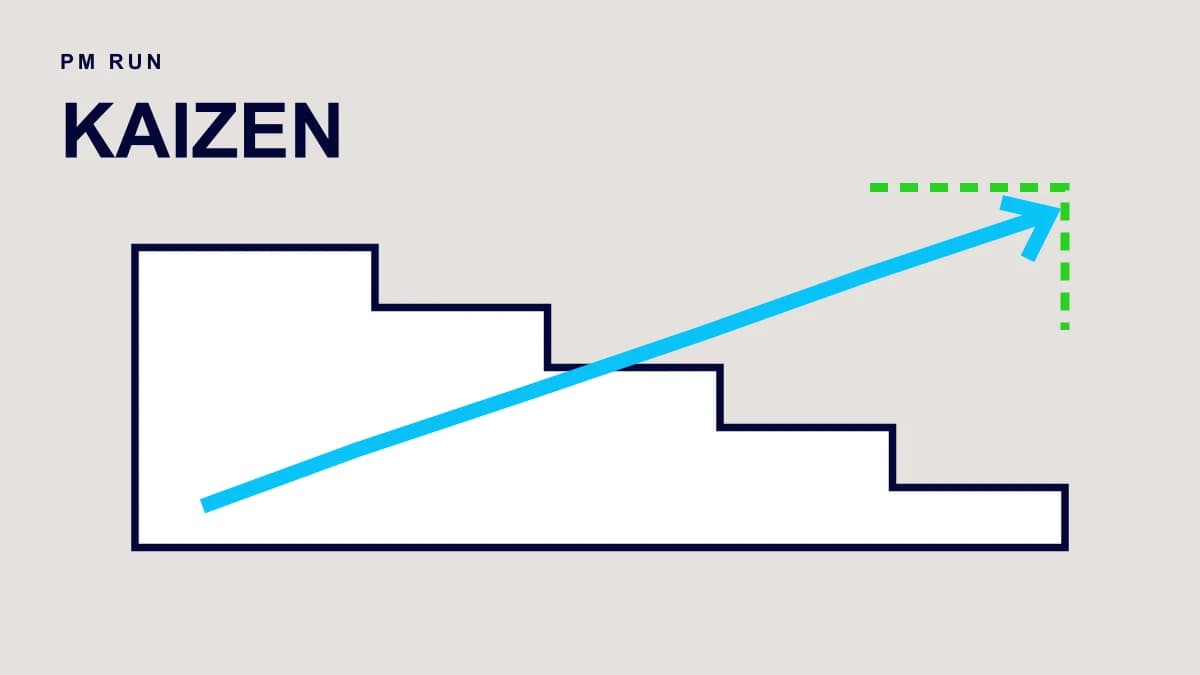
Kaizen is continuous improvement carried out with the people who know the work. In maintenance, a Kaizen event concentrates observation, analysis, testing, and standardization on a bounded loss. The gain must survive the event and appear in the real flow.
The confirmation-flow Kaizen addresses an administrative loss with technical consequences: field work ends, but SAP PM receives data too late to replan the week. The event bounds one order family, measures waiting and rework, and pilots a smaller flow before changing the routine for everyone.
When Kaizen in Maintenance is the right tool
Use it when a recurring workflow contains observable waiting, rework, or information handoff that a multidisciplinary team can test within a controlled scope. Before the first workshop, define the decision object, observed period, technical approver, comparison condition, and official source of record.
A common misuse is gathering ideas for several days, celebrating closed tasks, and returning operations to the old standard without an indicator, owner, or sustained audit. That behavior generates activity but does not establish changed condition. A method closes only when the decision enters the correct workflow and returns with reviewable evidence.
Minimum inputs before application
- Technical object: equipment, functional location, system, family, or workflow with an unambiguous boundary.
- Condition: expected function, observed deviation, consequence, time, and operating context.
- History: notifications, orders, confirmations, materials, measurements, and technical documents for the period.
- Decision rule: target, scale, hypothesis, internal criterion, or acceptance condition approved before results are known.
- Governance: technical owner, executors, approvers, dependencies, deadline, and authority to reopen the conclusion.
The field-to-SAP confirmation flow analysis starts by accepting what history does not yet prove. If physical finish time, synchronization, rejection, correction, and operation completeness is missing, the team opens a bounded collection task with a source, owner, and due condition. The gap receives no estimated score or reconstructed narrative; it explicitly limits what Kaizen can support.
Maintenance application steps
| Stage | Technical work | Required output | SAP PM handoff |
|---|---|---|---|
| Prepare | Define problem, scope, indicator, participants, restrictions, and data source before the event. | Short charter and validated baseline. | SAP PM orders and confirmations form the sample. |
| Observe current state | Follow real orders through execution, recording, supervision, and confirmation. Separate value, waiting, rework, and decision. | Flow map with elapsed times and loops. | Gemba and history show where information leaves the official flow. |
| Analyze and test | Select few obstacles and pilot countermeasures on one shift and one order family. | Pilot with entry, exit, and rollback rules. | PM Run Mobility can take orders to the field and return operation confirmation and allowed evidence. |
| Standardize | Adjust instruction, fields, training, exception rule, and supervision responsibility. | Approved new standard. | SAP PM remains the system of record. |
| Sustain | Track performance, audit samples, respond to deviations, and revise capacity or training. | D+7, D+30, and D+60 sustainment board. | Automated data can feed the custom panel built by the operation. |
Kaizen separates reasoning from execution for the field-to-SAP confirmation flow. Hypotheses and criteria remain in the analysis record. Physical work, inspection, and tests use an order; a new symptom uses a notification; a recurring change reaches a task list or plan only after the proper technical approval.
Complete industrial case: reducing the delay between field completion and order confirmation
Every person, asset, duration, quantity, and outcome in the field-to-SAP confirmation flow is didactic. The values demonstrate a completed Kaizen application without representing a PM Run customer, industry reference, regulatory threshold, or performance promise. A plant reusing the structure must replace its scales and criteria.
On Line 4, technicians completed work in the field, wrote notes on paper, and confirmed in SAP PM hours later. Planning spent the next morning reconciling records, and incomplete orders returned to supervisors.
Case baseline
| Data | Didactic value | Interpretation |
|---|---|---|
| Median physical-finish to confirmation | 19 h | Didactic sample of 80 orders |
| Orders confirmed only on D+1 | 32% | Concentrated on night and weekend shifts |
| Orders returned for missing data | 18% | Mostly hours, cause, and material |
| Weekly planning reconciliation time | 11 h | Didactic two-week observation |
Case target: reduce the median below four hours, bring D+1 below 5%, reduce returned orders below 5%, and sustain the result for eight weeks.
The cohort keeps the same order families and definitions of physical finish, valid confirmation, and return. Night work, weekends, variable connectivity, and material consumption are deliberately included. The median becomes invalid if difficult orders are excluded, and the gain is rejected if the review queue merely transfers the 11 reconciliation hours to supervisors.
Decision produced by the method
The pilot removed paper transcription for eligible orders, defined minimum closure fields, and created an offline exception route. Week four authorized a controlled continuation of the pilot, with median delay below four hours and returns below 5%, without bringing the sustainment decision forward.
The week-four decision kept the flow in pilot status for another four weeks, with a separate route for mandatory measurements or attachments. The record identifies the changed element, what remains, the release owner, and the return condition. Planning schedules it only after material, skill, access, duration, and acceptance are confirmed.
Indicator and verification window
Primary indicator: median time from physical completion to SAP PM confirmation, supported by D+1 percentage, return rate, and reconciliation hours.
Case calculation: Confirmation delay = confirmation timestamp minus recorded physical completion timestamp. Median is used so a few extreme cases do not hide typical behavior.
Window: daily review during the pilot, weekly meeting for eight weeks, and monthly audit after standardization.
Eight-week closeout
| Measure | Baseline | Week 4 | Week 8 | Criterion |
|---|---|---|---|---|
| Median physical-finish to confirmation | 19 h | 3.2 h | 2.8 h | Below 4 h |
| Orders reaching D+1 | 32% | 3% | 2% | Below 5% |
| Returned orders | 18% | 4% | 3% | Below 5% |
| Weekly planning reconciliation | 11 h | 3 h | 2 h | No hidden supervisory queue |
The eight-week review covered 160 orders, including night and weekend work, variable connectivity, and families with material consumption. All four measures remained within criteria during weeks five through eight without increasing the review queue. Governance retained the standard for compatible families, kept a separate route for mandatory measurements or attachments, and established a monthly audit. A median above four hours or returns above 5% for two consecutive weeks sends the flow back to design before further expansion.
Limits and neighboring methods
Limits: Kaizen does not replace technical failure analysis, engineering design, management of change, or risk priority. Faster entry with poor data quality only delivers bad information earlier.
Neighboring methods: PDCA governs successive cycles, Gemba reveals real flow, 5S stabilizes the workplace, and 5W2H organizes actions. Kaizen owns the focused improvement effort.
Method selection follows the question raised by the field-to-SAP confirmation flow. PDCA expands the cycle, A3 structures the narrative, and value-stream mapping locates waiting. Kaizen releases the confirmation flow after lead time, completeness, and rework meet the pilot criterion across representative shifts; PDCA or A3 retains decisions requiring a wider horizon or analysis.
Current state, bounded experiment, and controlled expansion
The current state starts at physical completion and ends when a valid confirmation reaches SAP PM. Waiting is classified by connectivity, review, correction, and approval. Median lead time represents typical flow, while the upper percentile exposes orders trapped by exceptions.
The event selects one order family with similar fields and risk. It defines operation-level confirmation, a minimum technical note, material treatment, and an attachment rule. Orders requiring measurements stay on an explicit exception route.
Week one tests completeness with the pilot crew. Week two adds variable connectivity. Week three includes material consumption. Week four includes weekend execution. Daily review changes one rule at a time and counts a fast but incomplete confirmation as a process defect.
Four-week pilot board
| Week | Primary test | Median | D+1 | Returns | Weekly reconciliation |
|---|---|---|---|---|---|
| 1 | Pilot crew and completeness | 8.0 h | 14% | 10% | 8 h |
| 2 | Variable connectivity | 5.6 h | 9% | 7% | 6 h |
| 3 | Orders with material consumption | 3.9 h | 4% | 4% | 4 h |
| 4 | Night and weekend work | 3.2 h | 3% | 4% | 3 h |
Expansion requires median delay, share within four hours, rework, and completeness to meet the target across representative shifts. Adoption proceeds by order family with an owner and date. A documented exception remains outside the standard until a safe route exists.
Orders, operations, user status, confirmations, notes, and consumption form the trace. PM Run Mobility shortens field-to-record distance, including offline synchronization; Planning uses earlier return to replan capacity. SAP PM remains the system of record.
Leaders verify that faster confirmation did not delete evidence or export work to another team. The platform does not approve technical closure. If quality falls, the previous flow is restored and the learning remains documented.
- Did night and weekend shifts reproduce the gain?
- Did rejection fall without evidence loss?
- Were measurement orders handled by the exception?
- Did earlier return improve replanning?
Controlling the standard after the event
The new flow enters the planning cycle with an owner, version, and exception list. Each order family must show compatible fields and risks before adoption.
PM Run Mobility can shorten field-to-SAP return, including offline execution. The indicator separates physical finish, synchronization, review, and acceptance so connectivity is not confused with technical rework.
At week eight, governance retained the standard for compatible families and preserved the controlled exception routes. It also measures administrative load on supervision and planners.
A technician-time gain that creates an invisible approval queue does not complete Kaizen. Balancing measures include rejection, missing evidence, and pending closure by owner.
The event record preserves rejected ideas and the reason they were not tested. That prevents the next team from repeating the same debate without new evidence.
Additional control questions
The daily board separates orders waiting for synchronization, technical review, and correction after rejection. Each queue has a different countermeasure. Combining all as open orders would hide whether loss comes from connectivity, record quality, or approval capacity.
Where operationally safe, expansion keeps a short control sample on the previous flow. Comparison reveals seasonality and team learning. After the decision, the old version closes with date and reason so two standards cannot coexist invisibly.
The facilitator limits work in progress during the event. New ideas enter a parking area unless they affect the tested flow. This protects the experiment from scope growth and gives untested proposals an explicit owner.
Sustainment review examines whether supervisors created manual spreadsheets or messaging workarounds. A faster official flow that depends on hidden parallel control has not removed waste.
The event record preserves the former state, tested hypothesis, approved change, exceptions, and sustainment evidence. Untested ideas remain separate from standard work. A suggestion created during the workshop does not become mandatory merely because the pilot succeeded.
Capacity effects are reviewed on both sides of the handoff. Faster technician confirmation may create more immediate review demand for supervisors. The design sets a visible work-in-progress limit and escalation path so delay is removed rather than shifted.
The pilot charter names the problem boundary, order family, start condition, end condition, owner, and rollback trigger. It excludes redesign of unrelated approval or material processes. Daily review uses a small defect log with order number, failure point, correction, and learning for the next cycle. When a rule changes, the team notes the effective date so earlier and later orders are not compared under different standards. Supervisors receive explicit review capacity, and planners see pending confirmations by reason. After expansion, a sustainment sample checks operation-level completeness and interviews users about hidden workarounds. An unofficial spreadsheet, copied note, or message-based approval indicates that waste moved outside the measured flow. The standard remains approved only while the official route carries the full technical record.
The sustainment owner reviews a fixed cohort by order family and shift instead of replacing difficult cases. Every defect records correction time and effect on replanning. The team counts unofficial messages, spreadsheets, and copied notes because these workarounds reveal steps missing from the official route. A frequent exception returns to process design rather than remaining permanently outside the standard. Expansion approval states review capacity, maximum acceptable queue, and escalation when that limit is reached. This prevents faster field confirmation from generating hidden backlog for supervisors or planners. At the final review, participants compare the tested hypothesis with actual behavior and retain untested ideas separately, each with an owner or an explicit decision not to pursue.
Technical sources
- U.S. Environmental Protection Agency, Lean Thinking and Methods, Kaizen, a primary or neutral reference for the method.
- SAP Help Portal, Maintenance Order.